Amber Hunt awarded the 2016 Blair Prize in Japanese Studies

May 12, 2016
Image

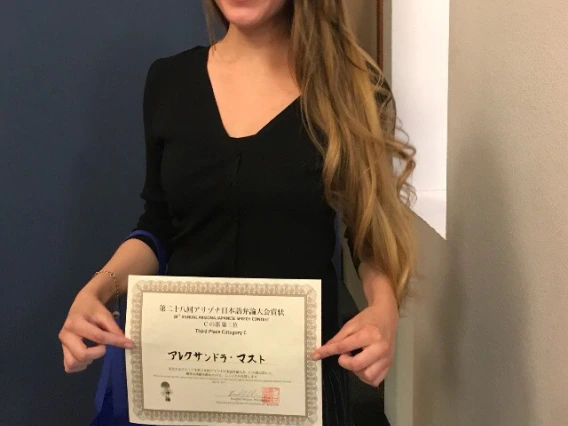
Please join us in congratulating Amber Hunt, who is the recipient of the 2016 Blair Prize in Japanese Studies.

Amber is graduating from the University of Arizona with a triple major in East Asian Studies, Political Science, and Linguistics, and a minor in Spanish. Amber has also served as one of our College of Humanities Ambassadors, representing our department and advocating for Humanities both on and off campus. Her interest in East Asia began with her Japanese language courses at the University of Arizona, prompting her to study other East Asian Studies courses. Her overall decision to major in East Asian Studies was the result of her Japanese language instructors and her advisor Dr. Camp, all of whom encouraged her throughout her time in the program.  Immediately following graduation Amber will move to Himeji, Japan and begin teaching English as a participant of the Phoenix Sister City's Teach Abroad program. She's already proven that she is a great representative of both the Department of East Asian Studies and the University of Arizona. Congratulations, Amber!

MA Student Christianne Ono Participates in 2015 Miyako Language Documentation Training Workshop in Japan

Jan. 21, 2016
Image

This past December, M.A. student Christianne Ono travelled to Ikema Island in southern Okinawa to participate in Dr. Tsuyoshi Ono (University of Alberta) and Dr. Toshihide Nakayama’s (Tokyo University of Foreign Studies) Second Miyako Language Documentation Training Workshop. During the intensive week-long workshop, Christianne and the other participants learned about and utilized various techniques to practice documenting Ikema, an endangered Ryukyuan language. In addition to linguistic research experience, they also spent time connecting with and giving back to the community by participating in local events and assisting with the after school care program.

New Book from Professor Jiang Wu

Dec. 21, 2015
Image

The Department of East Asian Studies is proud to announce the publication of Spreading Buddha's Word in East Asia: The Formation and Transformation of the Chinese Buddhist Canon, edited by our own Professor Jiang Wu in conjunction with Lucille Chia of the University of California Riverside. The volume follows the making of the Chinese Buddhist canon from the fourth century to the digital era, bringing together investigations of the religious, social, and textual practices of canon formation in the development of East Asian Buddhist culture. The book is published by Columbia University Press.

Liming Wang Recent Graduate in East Asian Studies Ph. D. Program

Oct. 27, 2015
Image

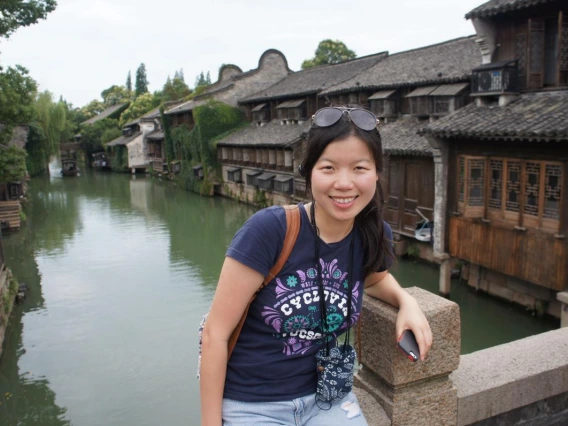
Liming Wang’s Biosketch

Liming was born and raised in a small village in northern China. Her fraternal grandfather was an intellectual but was persecuted and “sent down” during the Cultural Revolution. He had to relocate to a village from a coastal city and “re-educate himself” through farming. As a result, her father was forced to quit grade school to help on her grandparent’s farm. Her mother is illiterate. Nevertheless, education was always highly valued in her home.

Liming was a top student in both grade school and middle school. With a strong desire of changing her rural household registration (hukou) to an urban hukou, following her parents’ and teachers’ advice, she chose a four-year vocational school instead of high school. Her major was accounting.

Liming graduated from the vocational school in 1998. In 1999, she was assigned a job in a state-owned factory by the municipal government close to her hometown. She successfully changed her rural hukou to the urban hukou, which was highly desirable in China before the 2000s. 

However, at the beginning of 2000, the privatization process of state-run factories affected the city and the factory where she was working. Over 200 employees in that factory were laid off. She was one of them.

During the year 2000 to 2002, she took several jobs such as cashier at a supermarket, marketing representative in a newspaper agency, and sales representative in a jewelry store. Extremely disappointed at her life situation, she decided to make a big change. After months of preparation, she took the national higher education entrance exam (gaokao) and was admitted to Dalian University of Foreign Languages.

Upon completion of her bachelor’s degree in 2006, she pursued a master’s degree in Applied Linguistics in Dongbei University of Finance and Economics. After she received her master’s degree at the end of 2008, she had to make a decision between taking a job offer in Lijiang Normal University and pursuing a doctoral degree in East Asian Studies in the University of Arizona. She eventually decided to take the venture to come to the United Stated due to personal reasons. 

As a farmer’s daughter, she never forgot the farming days with her parents. The natural affection for farmers led to her dissertation research project. She conducted a 5-month fieldwork in five Chinese villages and finished her dissertation titled “The Making of New Farmers in Chinese Risk Society” in May 2015.

As Liming reflects on the course her life has taken, she believes that knowing oneself and what one want is fundamental. The courage and ability to make a change in times of adversity is crucial. Once a decision is made, even as difficult one as taking a PhD, perseverance and determination will unfailingly lead one to success.

Liming recently accepted a position at Embry-Riddle Aeronautical University in Prescott, Arizona, to teach Chinese language and culture courses in the Department of Humanities and Communication, College of Arts and Sciences. Best wishes to her in her continued adventures! 


Alumni News

Sept. 29, 2015
Image

Mark Metcalf, an alumni of East Asian Studies, received his Masters of Art in EAS in 2001. His MA thesis, entitled Warring States Political Rhetoric and the Zhangguo Ce Persuasions, was directed by Dr. Anna Shields. Mark later received an MPhil from Cambridge University under the supervision of Dr. Roel Sterckx, who was also an EAS faculty member at the University of Arizona. Mark has recently retired from the University of Virginia, where he taught courses including “Introduction to Traditional Chinese Literature” and “Sunzi and The Art of War”. Over the summer Mark made a presentation at the AAS-in-Asia conference, held at Academia Sinica, Taipei, Taiwan, from June 22-24. There he was able to have a nice reunion with his old professor, Dr. Jingshen Tao, EAS Professor Emeritus of Chinese history.  


Photo: Dr. Jingshen Tao, EAS Professor Emeritus (left) with Mark Metcalf (MA, 2001) at AAS-in-Asia, Taipei, June, 2015. 

Arizona in Shanghai

Sept. 8, 2015
Image

China is currently the fifth most popular study abroad destination among American college students, but UA has never had its own program in Mainland China before. In the summer of 2015, Department of East Asian Studies launched its Arizona-in-Shanghai program. We had 11 students as our first cohort, most of whom were going to China for the very first time. Arizona-in-Shanghai is a language-intensive program that recruits students with at least one semester of Chinese language. It is designed for students to take advantage of their time in China and have the opportunity for linguistic and cultural immersion. This time, the students’ background ranged from only one semester to three years of Chinese study. But, all of them shared a strong interest in learning more about the language and the society and a solid foundation of basic Chinese from the rigorous training in EAS’s language courses, which won them many thumb-ups from the local people in Shanghai.


As director of the program, Dr. Wenhao Diao designed the program curriculum to maximize students’ opportunities to interact with the local people. For example, students’ learning activities included giving oral presentations to Chinese college students about UA – and in Chinese. When our students translated UA’s battle song, Bear Down, and taught their Chinese peers to sing during the presentations, the University of Arizona and the city of Shanghai seemed to be weaved together just so naturally. The program also included a language practicum component that was designed to engage students in using language beyond the classroom and experiencing the local culture through language. For example, they went to visit a China’s National College Entrance Exam (known as gaokao in Chinese) site and Shanghai’s marriage market (where parents come and match make for their adult-age children on weekends). Language also became a lens through which the students could observe China’s cultural changes today. Some students were guided to analyze Shanghai’s linguistic landscape (e.g., street signs, billboards, etc.) in relation to the city’s globalization processes. During these events, students interacted with a wide range of people in Shanghai, ranging from the retired people practicing taichi in the park to young leaders of an underground LGQBT organization.


Certainly, language and culture learning didn’t stop at these curricular activities. When the students were visiting museums in the water town of Wuzhen, riding the boat on the West Lake, or doing kung fu with their Chinese master shi-fu, they also spoke Chinese. As a result, local people sometimes passed by and commented, “WOW! These foreigners’ Chinese is so good.”