Language Swap Tucson

When
7 p.m. – 8:30 p.m., Aug. 31 – Sept. 28, 2018

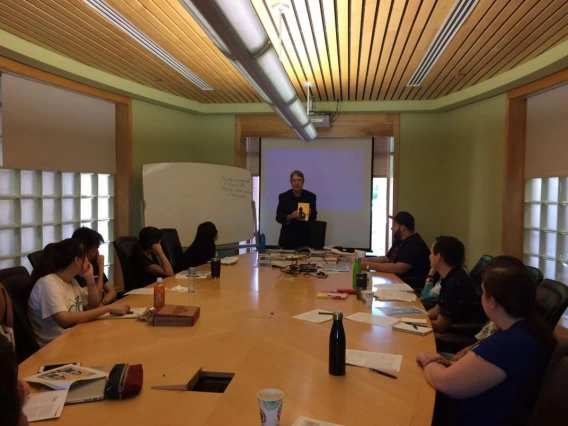
Practice Mandarin on Wednesdays, from 7:00 - 8:30 pm.

This is a free event near the University of Arizona, sponsored by Duolingo and not associated with the East Asian Studies Department. However, it's a wonderful opportunity for our students to practice their Mandarin.

Image

Chinese Bridge

April 28, 2018
Image

Congratulations to Anthony Burtman, an EAS major who won the First Place at the Advanced level in the Chinese Bridge Southwest U.S. Preliminary Contest, held at UA campus, April 28. Participants from Arizona, New Mexico and Texas competed in the event. Anthony gave an eloquent speech on the theme “One World; One Family”, citing his experience of studying Chinese medicine in Henan and drinking tea in the Ali Mountain in Taiwan. He also performed a musical piece. “Galloping Horses”, with the Chinese instrument Erhu in the talent show. Anthony will compete in the second round of Chinese Bridge competition in China this summer.


Olivia Bowers from UA won the Third Place at the Intermediate level, and Kianny Calvo received an Honorable Mention.


Thanks to Xia Zhang and Jingjing Xu, who spent much time helping students with their speeches.


Congratulations to Yi Wang, Ph.D. Candidate in Chinese Linguistics

April 18, 2018
Image

Congratulations to Yi Wang for winning the Tao-Chung Ted Yao Memorial Award at the Chinese Language Teachers’ Association (CLTA) Annual Conference, held in Washington DC, April 6-8. The paper she presented at the award competition is entitled ‘Navigating the Path: Language Ideologies among Long-term Study Abroad Students in China’.


The Yao Award was established by the Chinese Language Teachers Association in 2015. It supports graduate students in the U.S. to present papers at national or international conferences sponsored or organized by the CLTA. Each recipient receives a certificate and an award of $750 to defray conference expenses. 

The 29th Annual Arizona Japanese Speech Contest

April 8, 2018
Image

Julian Tran, our JPN 202 student, received a "most original" award at The 29th Annual Arizona Japanese Speech Contest. The contest was held at Pima Community College (West Campus). 

Julian's speech title was A Letter To Myself. The letter was to himself at age 14. This kind of style of speech was unique in a language speech contest setting. He gave very wise and heart-warming  advice, capturing the hearts of the audience and the judges. 

There were 37 participates altogether from the following schools: UA, PCC, ASU, NAU, Paradise Valley CC, Mesa CC, Glendale CC, Gilbert High School, Valley Vista HS. Two students from JPN 202 participated, and also two UA students came to volunteer. 

Dr. Takashi Miura participated as a contest judge.   

Miyako Inoue presents "Law’s Logistical Media: The Installation of the Filing System in the Postwar Japanese Prosecutor's Office"

When
2 p.m., April 19, 2018

Miyako Inoue is an associate professor for The Department of Anthropology at Stanford University. She graduated from Washigton University with her Ph.D in 1996. Professor Inoue has completed her first publication titled Vicarious Language: the Political Economy of Gender and Speech in Japan. The literature explores the phenomenon of "womens language" in modern Japanese society. She is also currently working on a second project, focusing on the development of Chinese shorthand. 

This presentation provides a semiotic and linguistic anthropological analysis of the filing system introduced in the Japanese Prosecutor’s Office in the aftermath of WWII, from the late 1940s to the early 1950s. At this time Taylor’s scientific management and Weberian visions of bureaucratic rationality in general expanded into public administrative offices as part of the democratization reform of the Japanese justice system pushed by the American Occupation. The post-war constitutional imperatives of democracy were translated into the mundane yet systematic operation of paperwork rooted in scientific management and the goal of bureaucratic efficiency. This presentation will discuss how the filing system amounted to a logistical mode of governing which spatially and temporally regulated the movement of people and things. The goal of this presentation is to consider (law’s) logistics as a form of power, which derives neither from rules nor disciplines, but from “disposition.” Beyond, and in addition to, the understanding of law hermeneutically as a relatively bounded discourse or set of rules, it shows the law's alternative mode of  existence viewed from its medial infrastructure.