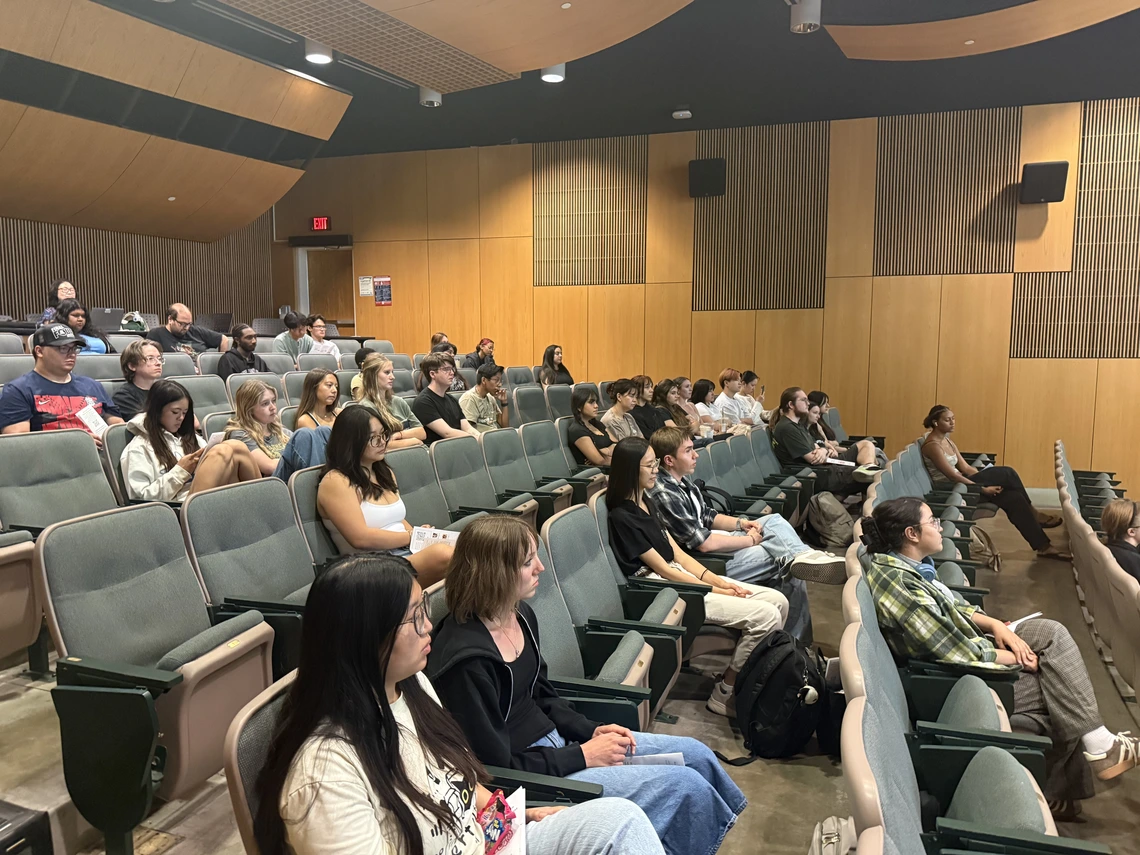
The Department of East Asian Studies hosted its annual award ceremony on Friday, May 8, 2026, to celebrate the graduating class of 2026 and to acknowledge its students for their exceptional performance and achievements during the academic year.
The following awards were given:
The Charles O. Hucker Founders Award for Excellence in Chinese Studies: The Charles O. Hucker Founders Award is named after Professor Charles O. Hucker, who came to the University of Arizona in 1956 and established the Oriental Studies Department, the predecessor of the University of Arizona’s current East Asian Studies Department and Near Eastern Studies departments. This award has been given annually since 1997 to honor a student for academic achievement in the field of Chinese.
Winners: Annie Chen and Edward Peng
Honorable Mention: Aurora Hudson Beeks
The Barbara Blair Prize for Excellence in Japanese Studies: The Barbara Blair Prize, started in 2007, is named after Barbara Bowman Blair (1925-2005). The Blair Prize was established both to honor Barbara Blair, and the academic accomplishments of U of A students, but also in the hope that the recipients will, in their own individual ways, contribute in the future to cross-cultural understanding, particularly between the nations of Japan and the United States.
Winner: Leah Lancaster
Honorable Mentions: Erin Balsa and Laurel Falk
The Center for East Asian Studies Graduating Senior Award: The Center for East Asian Studies (CEAS) has established this award to honor an outstanding graduating senior in East Asian Studies, especially those who have demonstrated achievement in the Korea Studies program.
Winner: Genevieve Kloch
Honorable Mention: Lily Jones
The East Asian Studies and Center for East Asian Studies Award: This award is being given in memory of Josiah Santos and his motto, ‘Do it scared; do it anyway.’ It is intended to celebrate someone who improvised, took a chance, or pushed their limits.
Winner: Claire Annalise De León
Honorable Mention: Chihiro Kazui
The Outstanding Senior Capstone Award
Winners: Margo Bartlett, Chris Ketterer, and Lake Goodrum Sterling
The Graduate Assistant, Teaching Special Recognition Award: This recognizes the outstanding contributions that the department's Graduate Assistants (GATs) have made to graduate teaching and the mission of the department.
Shyla Barton
Eunsil Cho
Nena Choi
Shi Li
Gregg Midon
Harrison Moffatt
Subin Oh
Yang Xing
Xingyu Wang
Yuwei Wang
Tengyun Zhang
The Center for Buddhist Studies - Khyentse Foundation Student Award: The Khyentse Foundation Student Award was established in 2018 at the Center for Buddhist Studies to encourage the University of Arizona graduate and undergraduate students to study Buddhism and its related subjects. Since 2001, Dzongsar Khyentse Rinpoche and a team of volunteers have been committed to providing funding for individuals and organizations seeking to make the dharma available to the world.
Winners: Quinn Anthony Veno, Miles Paige McDonald, and Ziling Wan
Honorable Mention: John Han
The Taiwan Economic & Cultural Office Chinese Achievement Award: Sponsored by the Taiwan Economic and Cultural Office (TECO), this award recognizes the highest-achieving student in each level of the Chinese Language Program’s classes.
CHN 101- Elementary Chinese I
Osarenren Kenneth Ize-Iyamu and Sean Masters
CHN 102 - Elementary Chinese II
Brynn Feinstein, Sumaya Eman Tarazi, and Brad Matthew Wong
CHN 201 - Intermediate Modern Chinese I
Mariko Tsujimoto
CHN 202 - Intermediate Modern Chinese II
Seungwoo Yu
CHN 302 - Third Year Chinese II
Addison Han
CHN 417 - Advanced Modern Chinese
Ronnie Laurel Beason
Congratulations to our students for their hard work and dedication to their academic careers!